
Educational Screen Time Activities for Kids
Practical educational screen time activities for kids. Choose quality interactive sessions that support real learning.
We design interactive coloring and learning activities that keep screen time purposeful for families.
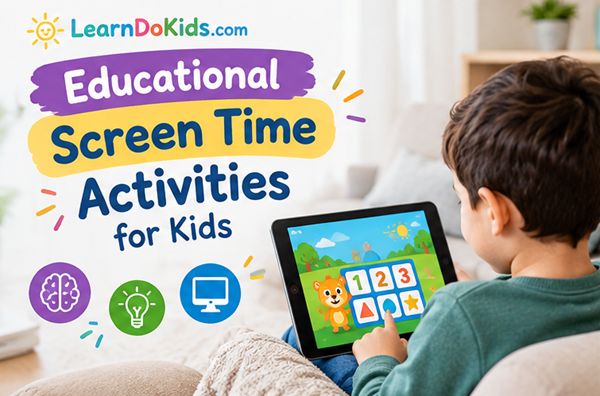
Parents in the US, UK, Canada, and Australia hear mixed messages about screens. Some days a tablet is the only way to cook dinner in peace. Other days guilt takes over. A more useful question than “Is screen time bad?” is this: What kind of screen time, for how long, and with what follow-up?
This guide focuses on educational screen time activities for kids—especially preschool and early elementary ages. You will learn how to spot quality interactive content, set simple family rules, and pair short digital sessions with offline play so learning does not stop when the device does.
Passive watching vs active learning
Not all screen time is equal. Passive watching (autoplay videos with little response) asks almost nothing of the child. Active use asks the child to choose, tap, solve, or create. Educational value rises when children think, not only when they stare.
Interactive coloring, simple puzzles, letter matching, and story apps that pause for a response tend to engage attention more than endless short clips. Your child’s age still matters: younger children need simpler goals and your presence nearby.
What quality educational screen time looks like
- Clear learning goal: colors, letters, sorting, or finishing a design—not only stimulation
- Age-fit challenge: large targets for preschoolers, more steps for older kids
- Short sessions: a natural end point so stopping is easier
- Low clutter: fewer pop-ups and random distractions
- Room for talk: you can ask, “What color is the bus?” while they play
Quality is also about your context. A calm 15-minute activity after school is different from two hours of background video during every meal.
Practical educational screen time activities
1. Tap-to-fill coloring with real object names
Choose one illustration—an apple, dog, or school bus—and invite your child to finish it. While they color, name the object and a fact (“Buses take children to school”). On LearnDoKids, designs in the gallery use clear sections so preschoolers can succeed without freehand drawing pressure.
2. Letter-of-the-day digital plus offline
Color the letter M online, then hunt for M words on a cereal box. Digital practice introduces the shape. Offline hunt makes it stick. Browse alphabet-style designs under ABC themes when you set up a child profile.
3. Teach me what you made show-and-tell
After any educational app, ask your child to explain one thing they did. Speaking about the activity builds language and helps you see whether the session was meaningful or only noisy.
4. Co-view and co-play
Sit for the first few minutes. Press start together. Your interest signals that this is purposeful time, not a babysitter replacement for the whole afternoon.
5. Timer plus transition plan
Set a visible timer. When it ends, move to a known next step: snack, outdoor play, or a book. Transitions fail when the only plan is “stop now” with nothing after.
6. Name card or personal project
Personal content holds attention. A colorable name card lets children tap each letter of their name—strong motivation for many kids and a natural literacy link.
Simple family rules that work in Western households
- Screens after basic needs: food, outdoor time, homework if any
- Devices in shared spaces when possible
- No autoplay rabbit holes during educational slots
- One activity goal per session (“finish the fish,” not “open anything”)
- Adults model the same rules at meals when they can
Rules only work if they are few and repeatable. Write them once and post them on the fridge if that helps your family.
How LearnDoKids fits a quality-screen plan
LearnDoKids is built around short, interactive coloring and simple learning activities—not endless feed scrolling. Parents create an account, add a child profile with an age group, and open activities or the gallery. You can read how it works and review privacy before you start.
Free use online keeps the barrier low for families testing whether educational screen time can feel calm instead of chaotic. Downloads may include a small watermark on free plans. The point of the product is still the activity: choose, color, finish, celebrate.
Balance with offline life
Even good screen activities should share the week with movement, books, and hands-on play. A healthy pattern for many families looks like: outdoor time, a short interactive session, then something offline related to the same theme (draw a paper bus after coloring a bus).
If your child is upset every time the screen ends, shorten the session and strengthen the transition routine before you add more apps.
Start with one intentional session
Pick one educational activity, one time limit, and one follow-up question. That single pattern—do, stop, talk—turns screen time from a blur into a habit you can stand behind. Explore the gallery, skim the blog, or start free when you are ready to try a focused session.
Try it on LearnDoKids
Browse clear coloring designs and start free with a parent account.